
Single-Use vs Reusable Surgical Instruments: When to Choose Each
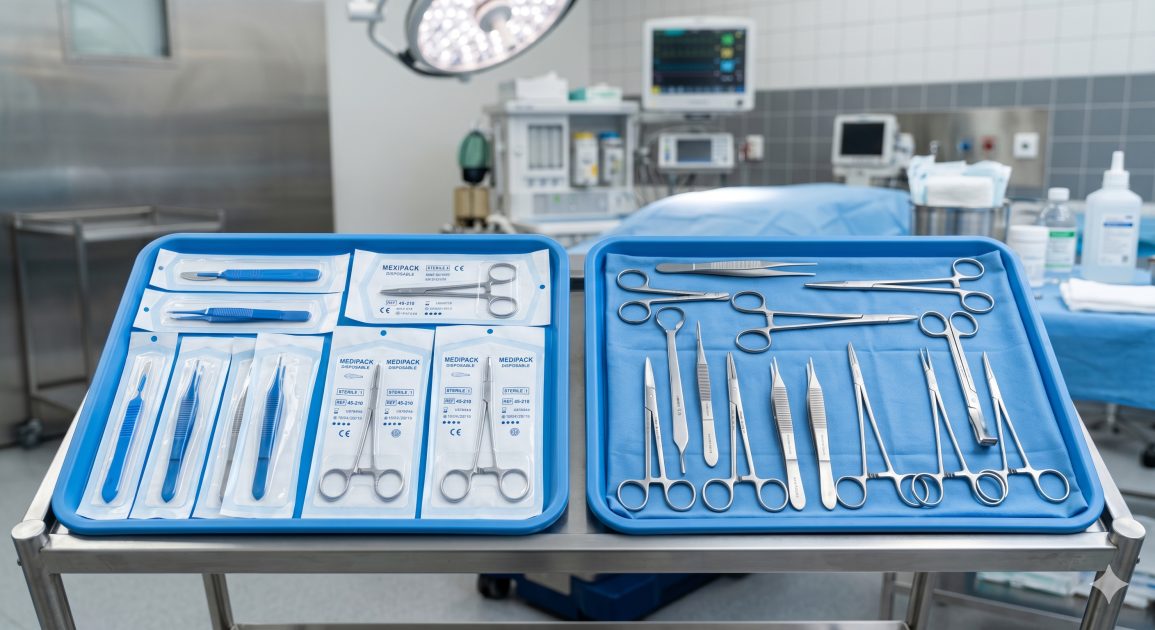
The choice between single-use disposable and reusable stainless steel surgical instruments is increasingly driven by regulation, infection control policy, and total cost of ownership — not just purchase price. This guide gives hospital procurement officers, distributors, and clinic managers a practical framework.
Key Differences at a Glance
| Factor | Single-Use | Reusable |
|---|---|---|
| Unit cost | Low ($0.50–$3 per use) | Higher upfront ($2–$50+), very low per-use over time |
| Lifecycle cost | High (ongoing per procedure) | Low (5–10 year lifespan) |
| Infection risk | Eliminated — new each time | Managed via validated sterile processing |
| Performance | Good for simple procedures | Superior — sharper, better tactile feedback |
| Sterilization needed | None | CSSD: autoclaving, ultrasonic cleaning |
| Environmental impact | Higher plastic waste | Lower — reused hundreds of times |
| Ideal setting | Field surgery, limited-resource settings, high-risk procedures | Hospitals, dental clinics, routine surgery |
| NHS guidance | Mandatory for some instruments (HTM 01-01) | Standard for most surgical instruments |
When to Choose Single-Use Instruments
1. High-risk infectious disease procedures
For patients with confirmed or suspected CJD (Creutzfeldt-Jakob disease), variant CJD, or unknown prion risk — NHS HTM 01-01 mandates single-use instruments for specific procedures. Standard autoclaving does not inactivate prions. Single-use eliminates this cross-contamination pathway entirely.
2. Limited or absent sterile processing facilities
Mobile surgical units, field hospitals, remote clinics, and emergency response settings often lack validated CSSD (Central Sterile Services Department) infrastructure. Single-use instruments remove the reprocessing requirement completely.
3. Complex-geometry instruments that are difficult to clean
Endodontic files, periodontic curettes with complex angles, and instruments with cannulated shafts are difficult to clean effectively. Retained organic material post-cleaning can compromise sterilization. Single-use is the safer choice.
4. Regulatory mandate in your market
The UK NHS HTM 01-01 guidance mandates single-use for specific instrument categories. Always check current guidance for your market as regulations are tightening across the EU under MDR 2017/745.
When to Choose Reusable Instruments
1. Routine surgery in facilities with validated CSSD
Hospitals and dental clinics with validated sterilization departments should use reusable instruments for routine procedures. Validated autoclaving at 134°C (18 minutes for wrapped loads) renders instruments safe for reuse.
2. High-volume procedure settings
A dental clinic performing 30 extractions per day cannot economically use single-use forceps. Reusable instruments become more economical after just 5–15 sterilization cycles for most instrument types.
3. Procedures requiring precise tactile feedback
Complex soft tissue procedures, microsurgery, and dental extractions with curved root morphology require the tactile feedback that quality stainless steel reusable instruments provide. Single-use instruments cannot match the functional performance of well-made reusables.
4. Long-term cost management
Over a 5-year period, a $10 reusable forceps used 500 times costs $0.02 per procedure. A single-use equivalent at $1.50 costs $750 over the same 500 procedures. For high-frequency instruments, reusable is the clear economic choice.
Cost Analysis: Break-Even Point
| Option | Unit Cost | Lifespan | Cost Per Use |
|---|---|---|---|
| Reusable (Pintech factory-direct) | $3.50 per instrument | 500 sterilization cycles over 7 years | $0.007 |
| Single-use equivalent | $1.20 per instrument | Used once, disposed | $1.20 |
Break-even: approximately 3 uses. After 3 sterilizations, reusable instruments become cheaper per procedure than single-use for every subsequent use.
Pintech Instruments: Both Options Available
Pintech manufactures both reusable stainless steel surgical instruments (our primary catalogue of 2,660+ items) and single-use instrument sets for distributors supplying NHS, Australian hospitals, and US ambulatory surgery centres. Single-use products are available as custom trays with your branding and CE/UKCA documentation.