
The Mechanics of Ligature Instruments: Wire Control in Orthodontic and Surgical Settings
The Mechanics of Ligature Instruments: Wire Control in Orthodontic and Surgical Settings
In both complex orthodontic reconstruction and maxillofacial trauma surgery, the manipulation, bending, and securing of archwires and stainless steel ligatures require absolute mechanical precision. When clinicians use a ligature instrument to tuck, twist, or cut rigid steel or Nickel-Titanium (NiTi) wire, the instrument experiences intense localized friction, shearing forces, and severe repetitive strain. If the steel matrix of the instrument is softer than the wire it is manipulating, the working ends will rapidly develop grooves, rendering the tool utterly useless for gripping and securing fine ligatures.
For procurement managers, global dental distributors, and supply chain directors sourcing inventory from dental instruments manufacturers in Pakistan, relying on generic catalog descriptions is insufficient. Understanding the specific metallurgical requirements, tempering curves, and mechanical tolerances of ligature tools is a critical requirement for risk mitigation. This comprehensive engineering blueprint provides a detailed breakdown of ligature directors, Mathieu needle holders, and wire-tying forceps, equipping enterprise buyers with the technical specifications necessary to source high-performance clinical tools capable of surviving the rigors of modern orthodontics.
1. The Biomechanics of Wire Control and Instrument Degradation
To evaluate the manufacturing requirements of a ligature instrument, procurement officers must first understand the clinical physics involved. Orthodontic archwires and surgical ligatures are typically manufactured from incredibly tough materials: cold-worked stainless steel, Beta-Titanium, or Nickel-Titanium (NiTi) alloys. These wires possess extremely high tensile strengths and resist plastic deformation.
When a clinician uses a standard, un-reinforced stainless steel plier to grip and twist these wires, the harder wire acts as an abrasive cutting tool against the jaws of the plier. Over the course of dozens of procedures, this friction carves deep grooves into the inner serrations of the instrument. Once these grooves form, the clinician can no longer secure a firm grip on the wire; the wire will spin, slip, or snap prematurely inside the jaws. Preventing this degradation requires advanced metallurgical engineering at the factory level, specifically concerning the integration of ultra-hard composite materials.
2. Mathieu Needle Holders and Ligature Tying Forceps
The Mathieu needle holder is a foundational instrument in any high-volume orthodontic clinic or maxillofacial surgical tray. Unlike standard hemostatic forceps that utilize traditional finger rings (requiring complex hand rotation), the Mathieu features a plier-style handle equipped with a specialized ratchet mechanism located at the base of the shanks. This design allows the surgeon to lock, hold, and unlock the instrument rapidly with a simple inward squeeze of the palm, making it ergonomically ideal for the rapid, repetitive motion of twisting elastomeric and stainless steel ligatures.
2.1 Double Leaf Spring Mechanics and Elastic Modulus
The rapid action of the Mathieu plier relies entirely on a double leaf-spring mechanism positioned between the lower handles. During the manufacturing process, these springs must be tempered to an incredibly precise degree of elasticity. The steel must operate entirely within its elastic deformation zone.
If the heat treatment of these springs is improperly calibrated, two failure states occur: 1. Over-hardened (Brittle): The steel's yield strength is too close to its ultimate tensile strength. After several hundred compressions, the crystalline structure will suffer from fatigue failure, causing the spring to snap violently mid-procedure. 2. Under-hardened (Soft): The steel possesses a low elastic modulus. It will bend permanently (plastic deformation), and the instrument will fail to spring open automatically when the base ratchet is disengaged by the clinician.
To prevent these failures, we utilize specialized austenitic steel alloys exclusively for the spring components, calibrating the cold-working and tempering cycles to ensure thousands of smooth, high-tension compressions without a single mechanical failure.
2.2 Jaw Serrations and Tungsten Carbide (TC) Integration
To overcome the rapid degradation caused by gripping rigid archwires, premium ligature instruments incorporate Tungsten Carbide (TC) inserts into the working jaws. Tungsten Carbide is an extremely dense, synthesized composite that registers vastly higher on the Vickers hardness scale than any medical-grade stainless steel.
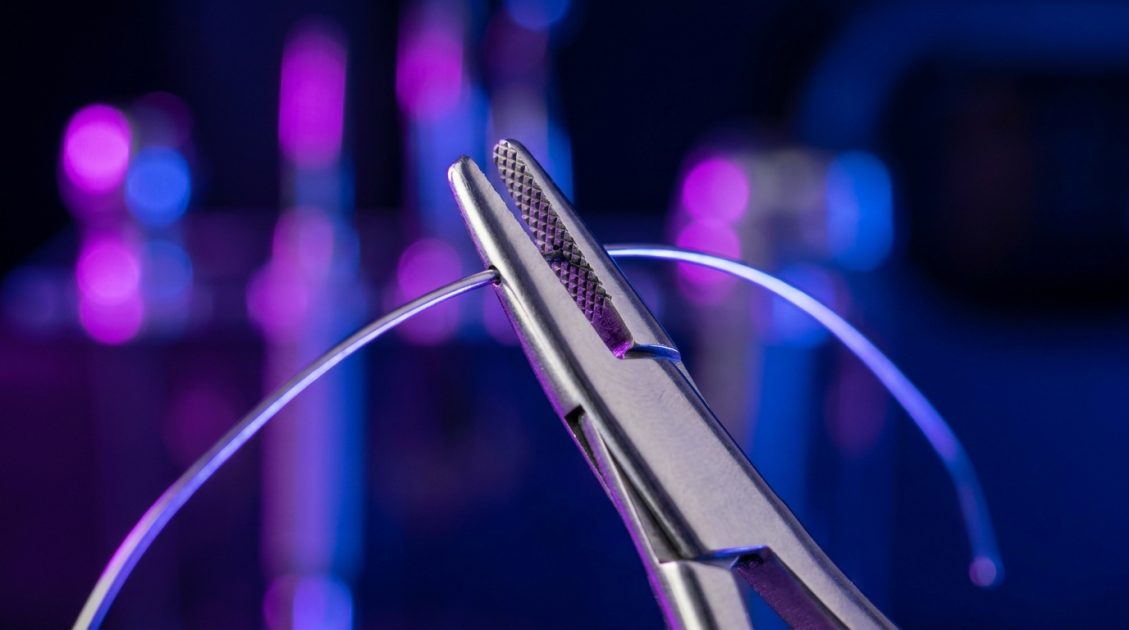
These specialized inserts feature a fine, cross-hatched (diamond-cut) serration pattern. This multi-directional texture allows the plier to grip smooth, cylindrical steel wire firmly without allowing it to roll laterally or slip out of the jaws under heavy rotational torque. Because the TC is exceptionally dense, it entirely resists grooving, maintaining its sharp abrasive grip long after a standard steel instrument would have been rendered useless.
2.3 Induction Brazing Tolerances
The integration of the TC pad is the most complex phase of production. The silver brazing process must be utterly flawless. We utilize high-frequency induction heating coils to melt a micro-thin silver-copper solder alloy between the TC insert and the milled stainless steel jaw. If the temperature distribution is uneven, capillary action will fail, creating invisible microscopic voids inside the joint. When the clinician applies heavy twisting torque to a ligature wire, the shearing forces will concentrate on these voids, causing the TC pad to fracture or completely shear away from the plier. Our rigorous shear-testing quality control ensures that every TC joint is perfectly contiguous and void-free.
3. Orthodontic Ligature Directors and Tuckers
Once a ligature wire is twisted and trimmed using a cutting plier, the sharp, exposed cut end of the wire remains dangerous. It must be safely tucked down and under the main archwire to prevent it from lacerating the delicate soft tissue of the patient's lips or cheeks. This is the specific, highly technical function of the ligature director (frequently referred to as a tucker).
3.1 Working End Geometry and Milling Tolerances
Ligature directors feature highly specialized working ends—typically a combination of a finely notched tip on one side and a scaler-like probe on the other. The notched tip is the critical engineering vector. It must be milled using high-precision CNC machinery to exact dimensional tolerances.
The notch must be wide enough to seamlessly capture standard orthodontic wire gauges (which typically range from 0.012" to 0.020" in diameter). However, it must be narrow and deep enough to prevent the wire from sliding out laterally during the firm downward tucking motion. If the notch is milled too wide, the instrument will slip off the wire at full force, potentially injuring the patient's gingival tissue.
3.2 Vacuum Heat Treatment and Tip Rigidity
Because the working tip of a ligature director is extremely thin, it is highly susceptible to bending under force. During the manufacturing process, these instruments undergo complex Vacuum Heat Treatment (VHT). Standard open-air heating causes surface oxidation and uneven carbon distribution, leading to weak spots.
In our VHT chambers, the oxygen is completely evacuated. The martensitic steel is austenitized at high temperatures, then rapidly quenched with pressurized nitrogen gas. This guarantees that the tips are hardened uniformly to a precise Rockwell scale (HRC 44-48). This exact metric ensures that when the orthodontist applies firm, directed pressure to bend a rigid archwire, the delicate tip of the instrument transfers all the kinetic energy directly into the wire without flexing, yielding, or snapping.
4. Sourcing Direct: The Engineering Advantage
Major orthodontic supply brands and hospital procurement networks require massive volumes of standardized dental instruments that perform flawlessly right out of the packaging. Relying on regional brokers introduces critical gaps in quality control, as brokers source from multiple fragmented workshops with varying metallurgical standards.
By sourcing directly from a specialized, primary factory in Sialkot, distributors gain absolute top-down control over the production parameters. Whether you require a specific cross-hatch pitch on a Mathieu TC insert, a modified handle length for ergonomic pediatric use, or a highly specific spring tension calibration, direct factory sourcing ensures these engineering requests are executed without deviation across bulk container shipments.
5. OEM Compliance and Strict Laser Etching Parameters
Consistent, readable corporate branding is a vital aspect of B2B medical device distribution. Hospitals and clinics build trust with recognizable brand names. However, applying laser marks to high-tensile tools that face intense mechanical stress and highly caustic chemical sterilization requires strict oversight. The laser process itself can destroy the instrument if not properly managed.
5.1 The Dangers of Heat-Affected Zones (HAZ)
Low-tier factories often use overpowered lasers to etch logos quickly. This excessive, localized heat creates a Heat-Affected Zone (HAZ) in the steel. The high temperature causes the chromium within the steel to bind with carbon, forming chromium carbides. This precipitation depletes the surrounding steel of the free chromium it needs to maintain its passive, rust-resistant Chromium-Oxide layer. As a direct result, the laser-marked area will begin to rust immediately upon its first entry into a hospital autoclave.
5.2 The 1:10 OEM Scale Rule
To entirely prevent this metallurgical failure, Pintech Instruments enforces a rigid OEM design constraint across all wholesale production lines: all custom corporate branding, logos, and UDI (Unique Device Identification) matrix codes must not exceed a 1:10 scale relative to the available flat image area of the instrument.
This specific spatial sizing rule ensures the laser's thermal energy dissipates safely into the surrounding steel mass, never allowing the temperature to reach critical HAZ thresholds. The result is a bold, crisp, rich-dark brand mark that is entirely free of grey thermal artifacts. This guarantees the logo will never serve as a nucleation site for rust or galvanic corrosion, ensuring absolute compliance with European MDR and US FDA aesthetic standards.
6. Optimizing Procurement and B2B Export Logistics
When securing international B2B wholesale orders for precision ligature instruments, the logistics routing must be as precise as the CNC milling. We support our wholesale distribution partners with automated, compliance-ready export infrastructure designed to bypass customs bottlenecks.
- Smart Carton Grouping: Delicate tools like ligature directors feature incredibly fine, sharp tips. To prevent metal-on-metal impact during turbulent ocean or air transit, instruments are grouped utilizing smart carton packing. The tips are protected with custom silicone caps, and the instruments are sealed in anti-moisture barriers before being logically arranged into rigid outer containers.
- Automated Customs Documentation: We automatically generate hyper-detailed proforma invoicing, complete with precise Harmonized System (HS) codes, verified certificates of origin, and comprehensive Declarations of Conformity (DoC).
- Traceability and Technical Files: Every bulk shipment is fully traceable back to the raw material heat numbers, accompanied by documented VHT hardness logs and ISO 13485 compliance certificates, ensuring immediate clearance at your regional distribution hub.